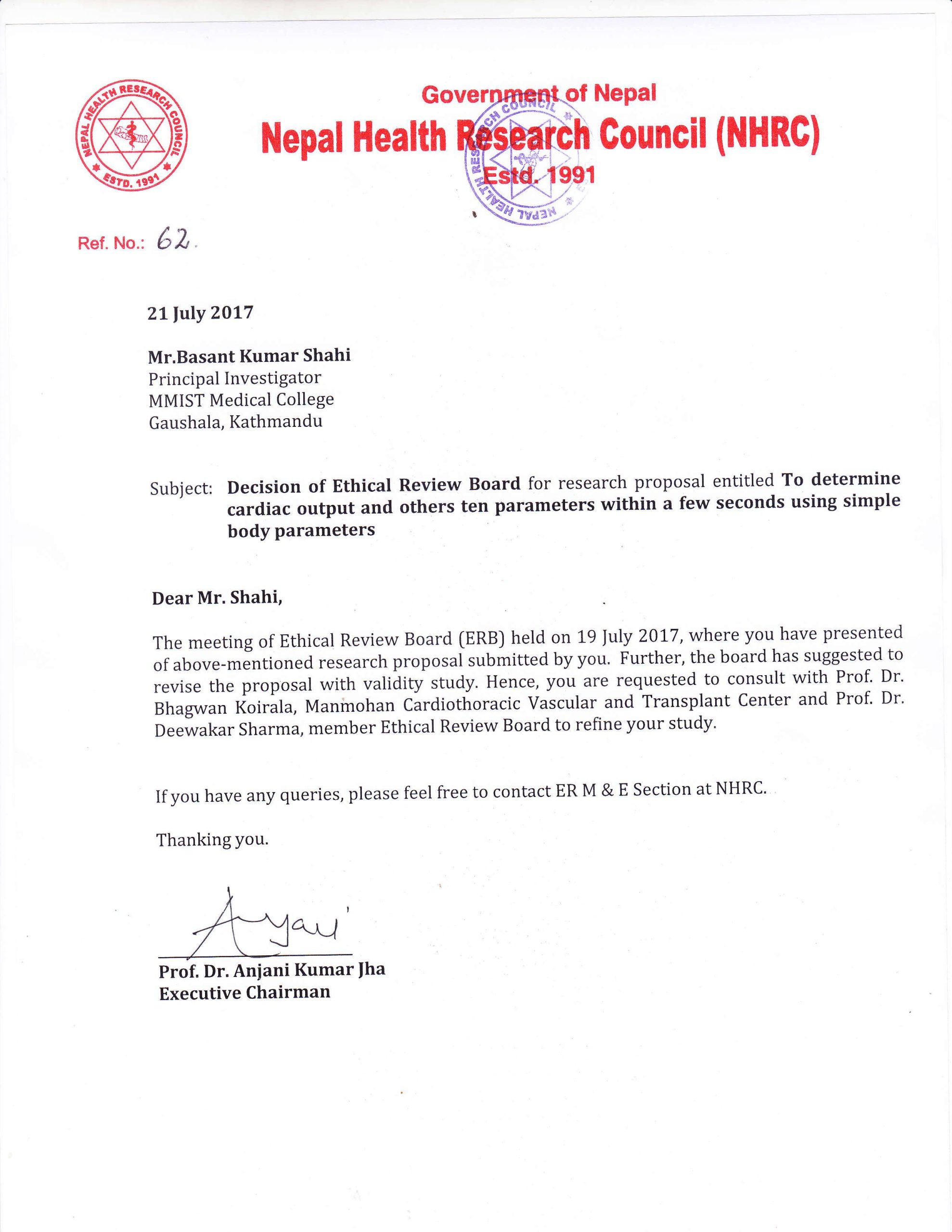
Published Article- ResearchGate
“To determine cardiac output and others ten parameters within a few seconds using simple body parameters”
No one is allowed to sell, rewrite, or prohibit this work as it is fully copyrighted by Principal Investigator Basant Kumar Shahi
Summary of the proposal (Structured):
The cardiac output is the easily determined by using simple body parameters like, heart rate, respiratory rate. Heart rate is the directly proportional to respiratory rate, body temperature and cardiac output and indirectly proportional to body weight. Using the different parameters and their relation formula is derived and cardiac output is the main react. Despite of cardiac output stroke volume, cardiac index, stroke volume index, body surface area, plasma cell volume, total red blood cell volume, total plasma volume , total blood volume cell in tachycardia acute blood in total blood volume in bradycardia . Acute blood loss during the process experiment was carried out in approx 50 individuals who care act to be correct for 90% Introduction.
Background:
The previous method used for cardiac output is very difficult in the aspect that, it is expensive requires skilled human resources and requires enough time so; the most significant aspect of the study is that this method for the determination of cardiac output has multiple advantages. It is very practical phenomena in the sense that it saved time how like cardiac output of the people and could be taken advantages by maximum of the population. Since it uses the simple body parameters/vitals, it could be operated in an individual’s level as well. Similarly it doesn’t required any skilled however resources. The great advantage/ merits are it. Also assists in calculating other ten body measures within very ten times which is obviously a great achievement in medicine. The bother body measures are as follow: Cardiac output, Stroke Volume, Cardiac Index, Stroke Volume Index, Body surface area, Total plasma cells, Total red blood cells, Total blood volume, Total blood volume in tachycardia, Total blood volume in bradycardia.
Rationale/justification:
Cardiac output and its determination is one of the challenging aspect in medicine and discovering. It requires a technical human resource, time and high expensive which is not always practical considering this our finding that is Auto Cardiac Digital Device ACDD easily find out the cardiac output of a human and others ten vitals just by using body vital likes Respiration Rate, Heart Rate, Body Temperature, Body Weight and Body Height. Thus it will be very effective in majority of a population ranging from rich to poor. Auto Cardiac Output is very useful in the day to day to aspect of life since it signifies the physiological and pathological status of body in which it is functioning. Despite of the cardiac outputs, it and help in deterring other ten body parameters like Cardiac Output, Stroke Volume, Stroke Volume Index, Cardiac Index, Body Surface Area, Total Blood Volume, Total Blood Volume in Tachycardia and Total Blood Volume in Brady cardiac. Since, passion can find his physiological status of a body. Using this device they will be conscious enough regarding their health and enhance the healthy life style. The modern methods of determining cardiac output although they are helpful but requires enough time and cardiac output in passion with serious conditions like cardiac arrest, myocardial infarction MI, angular Prospector and ventricular spectral defect should be found within no time. Thus, it will be one of the best methods.
Specific Objective:
- To make it more accurate 2. To provide service to everyone either poor rick. 3. To make it useful in patient with serious complication.
General Objective:
- To determine cardiac output within low cost and in a very short time and assailable to every individual.
Research Hypothesis:
Respiratory rate, body temperature, body weight, heart rate and body weight some relation either direct or indirect with that of the cardiac output. Thus, combining all those relations we can get the cardiac output. Cardiac output which is the product of stroke volume and heart rate depends upon it. The mathematical relation of the different variables with cardiac output has been derived and accordingly the cardiac output is measured.
Expected outcome of the research results:
The most significant thing is that it will determine Cardiac output using simple’s variables and the people who lack health care in several areas are also equally benefited by this outcome. One doesn’t require an injection or a surgery thus, it is expected to be applicable in those individual who couldn’t tolerate the pain as well.
Plan for utilization of research findings:
Researchers finding will be like majority of population in low cost giving exact medical and easily.
Data collection tools:
“Thermometer for reading body temperature, measuring tape for measure body height, stopwatch for respiratory rate and heart rate weighing for body weight measures”
Informed consent is obtained from the research participants:
We approached to the patients and asked them patients parties weather they are interested to participated and give there few minutes or not.
Conceptual Framework:
H.R
During exercise, your adrenal gland increases production of adrenaline and noradrenaline that directly affect the heart and the ability to transport oxygen and carbon dioxide throughout the body. The hormones then directly influence the sympathetic nerves to stimulate the heart to beat stronger for increased stroke volume and faster for increased heart rate and an overall increase in cardiac output.Your heart rate, or pulse, is the number of times your heart beats in a minute. Depending on your age and level of physical fitness, a normal resting pulse ranges from 60 to 80 beats per minute. Your breathing rate is measured in a similar manner, with an average resting rate of 12 to 20 breaths per minute. Both your pulse and breathing rate increase with exercise, maintaining a ratio of approximately 1 breath for every 4 heartbeats.
H.R
An increase in body temperature (BT) is followed by an increase in heart rate (HR) and respiratory rate (RR). Only a few studies have explored the magnitude of this increase. These studies all included young healthy study subjects not taking any medicine that influenced the cardiovascular system. We wished to investigate this relationship in a study group more representative of the acute patients we meet in an emergency department.
Body temperature is an independent determinant of heart rate, causing an increase of approximately 10 beats per minute per degree centigrade. Body temperature is also an independent determinant of respiratory rate. This quantification may help in the assessment of the hot and unwell child, to determine whether any tachycardia or tachypnoea is caused solely by fever, or whether there may be an element of concurrent shock.
The present study determined whether EEG and/or EMG recordings could be used to reliably define activity states in the Brazilian black and white tegu lizard (Tupinambis merianae) and then examined the interactive effects of temperature and activity states on strategies for matching O2 supply and demand. In a first series of experiments, the rate of oxygen consumption ([Formula: see text]), breathing frequency (f R), heart rate (f H), and EEG and EMG (neck muscle) activity were measured in different sleep/wake states (sleeping, awake but quiet, alert, or moving). In general, metabolic and cardio-respiratory changes were better indictors of the transition from sleep to wake than were changes in the EEG and EMG. In a second series of experiments, the interactive effects of temperature (17, 27 and 37 °C) and activity states on f R, tidal volume (V T), the fraction of oxygen extracted from the lung per breath (FIO2-FEO2), f H, and the cardiac O2 pulse were quantified to determine the relative roles of each of these variables in accommodating changes in [Formula: see text]. The increases in oxygen supply to meet temperature- and activity-induced increases in oxygen demand were produced almost exclusively by increases in f H and f R. Regression analysis showed that the effects of temperature and activity state on the relationships between f H, f R and [Formula: see text] was to extend a common relationship along a single curve, rather than separate relationships for each metabolic state. For these lizards, the predictive powers of f R and f H were maximized when the effects of changes in temperature, digestive state and activity were pooled. However, the best r (2) values obtained were 0.63 and 0.74 using f R and f H as predictors of met abolic rate, respectively.
H.R
Heart rate is, also known as pulse, is the number of times a person’s heart beats per minute. A normal heart rate depends on the individual, age, body weight, heart condition, whether the person is sitting or moving, medication use and even sir tempura. Even emotions can have an impact on heart rate. For example getting excited or scared can increase the heart rate. But most importantly, getting fitter lowers the heart rate muscles work more efficiently.
Your heart is a muscle and just like strengthening other muscles by going activities, you can do the same thing with your heart. If you area n athlete and you’re training, or if you are having symptoms such as dizziness, then knowing your heart rate is important, so increase the heart rate also decrease the body weight.
H.R
Every minute, what you’re really doing is increasing your cardiac output. And, from our equation, we see that this means you either increased your heart rate or your stroke volume or both.
The function of the heart is to drive blood through the circulatory system in a cycle that delivers oxygen, nutrients and chemicals to the body’s cells and removes cellular waste. Because it pumps out whatever blood comes back into it from the venous system, the quantity of blood returning to the heart effectively determines the quantity of blood the heart pumps out – its cardiac output, Q. Cardiac output is classically defined alongside stroke volume (SV) and the heart rate (HR) as:
Ten young (average age 20 years) healthy male volunteers performed the Valsalva maneuver (40 mmHg for 15 seconds) in the supine and the upright position. The heart rate (HR), stroke volume (SV) and the cardiac index (CI) were registered using ECG and impedance cardio graph. During the expiratory strain of the Valsalva maneuver the HR increased about equally in the two positions while the decreases in the SV and the CI were in the supine position significantly greater than in the upright position. The CI decreased to equal levels in both positions after 15 seconds of strain. The rise in the HR due to the expiratory strain did not correlate significantly with the decrease in the CI in either position. The correlation between the HR rise and the SV decrease was almost significant (p less than 0.05) in the supine position and significant (p less than 0.01) in the upright position after 5 seconds of strain but not after 10 or 15 seconds. These observations suggest that the relationship between the rise in the HR and the decrease in the venous return does not remain constant during 15 seconds of expiratory strain. Perhaps the cardiopulmonary baroreceptor reflexes affect the HR after five seconds of strain more than they do after 10 or 15 seconds of strain.
Cardiac function curves are widely accepted to apply to humans but are not established for the entire range of filling of the heart that can be elicited during head-up (HUT) and head-down tilt (HDT), taken to represent minimal and maximal physiological filling of the heart, respectively. With the supine resting position as a reference, we assessed stroke volume (SV), cardiac output (CO) and filling of the heart during graded tilt to evaluate whether SV and CO are maintained during an assumed maximal physiological filling of the heart elicited by 90 degrees HDT in healthy resting humans.
From supine rest to 60 degrees HUT, SV and CO decreased 23 ml [confidence intervals (CI): 16-30; P<0.001; 23%] and 0.9 l/min (0.4-1.4; P<0.0001; 14%), respectively, but neither SV nor CO changed during HDT up to 70 degrees. However, during 90 degrees HDT, SV decreased 12 ml (CI: 6-19; P<0.0001; 12%), with an increase of 21 ml (9-33; P=0.002; 16%) in LVEDV because HR increased 3 bpm and CO decreased 0.5 l/min (ns).
This study confirmed that SV and CO are maximal in resting, supine, healthy humans and decrease during HUT. However, 90 degrees HDT was associated with increased LVEDV and induced a reduction in SV.
H.R …………………………… (V)
H.R ………………………… (VI)
Combination all equations we get,
H.R
H.R
(Where K is the supporting unit of the cardiac output it is value 1.8 For Male and 1.95 For Female minkgl2/ m4o0c)
All normal patients’ same K value is 1.8 & 1.95 from newborn to elder.
In case any pathology or abnormal vital value.
K=
C.O=
C.O=
C.O =
Both side square we get,
C.O = C.O =
In Male K= 1.8 In Female K= 1.95
C.O = C.O =
C.O = C.O =
| C.O= l/min
For Male |
C.O = L/min For Female |
Unit:
C.O= liter/minute.
Stroke Volume:
S.V=
S.V=
S.V=
| S.V= ml/beat
For Male |
S.V= *1000ml/beat
For Female |
Unit:
l/min*min
(Note: beat= min*min)
So, Stroke Volume unit is l/beat or ml/beat)
Cardiac Index (C.I) =
C.I=
Both side square
C.I.=
Unit:
l/min/
| C.I= l/min/ | C.I= l/min/ |
Stroke Volume Index (S.V.I) = *1000
S.V.I= *1000
S.V.I=
Unit: (1liter= 1000ml & min*min= beat)
ml//beat
| S.V.I= ml//beat
For Male |
S.V.I= ml//beat
For Female |
| Body Surface Area (B.S.A) = m2 |
Total Blood Volume (TBV)
TBV ……………….. (VI)
TBV
(Where K is just supporting of the Total Blood Volume TBV)
TBV
TBV=
……………………… (VII)
K value put in equation (VI) we get,
K=
K =
Both side square we get,
(K)2= 2
4(K)2=
= 4K2
= 4K2
K=
Total Blood Volume TBV: K
TBV=
TBV= B.H
| TBV= B.H |
Total Red Cell Volume (TRCV):
TBV*
TRCV= B.H*
TRCV= B.H
TRCV= B.H
| TRCV= B.H liter |
Total Plasma Volume TPV:
TPV= B.H*
TPV= B.H
TPV= B.H
| TPV= B.H liter |
Total Blood Volume in Acute Hemorrhage:
Tachycardia:
| TBVT= TBV liter |
Bradycardia:
| TBVB= liter |
| S.N. | Finding Formulae |
| 1. | Cardiac Output C.O= l/min |
| 2. | Stroke Volume S.V= ml/beat
|
| 3. | Cardiac Index C.I. l/min/ |
| 4. | Stroke Volume Index S.V.I. ml//beat |
| 5. | Body Surface Area (B.S.A) = m2 |
| 6. | Total Blood Volume (TBV)= B.H liter |
| 7. | Total Red Cells Volume (TRCV)= B.H liter |
| 8. | Total Plasma Cells Volume (TPV)= B.H liter |
| 9. | Total Blood Volume in Tachycardia Acute Blood Loss: TBVT= TBV liter
|
| 10. | Total Blood Volume in Bradycardia Acute blood loss: TBVB= liter |
“Auto Cardiac Digital Device ACDD”