“Auto Cardiac Digital Device ACDD”
“Auto Cardiac Digital Device ACDD”
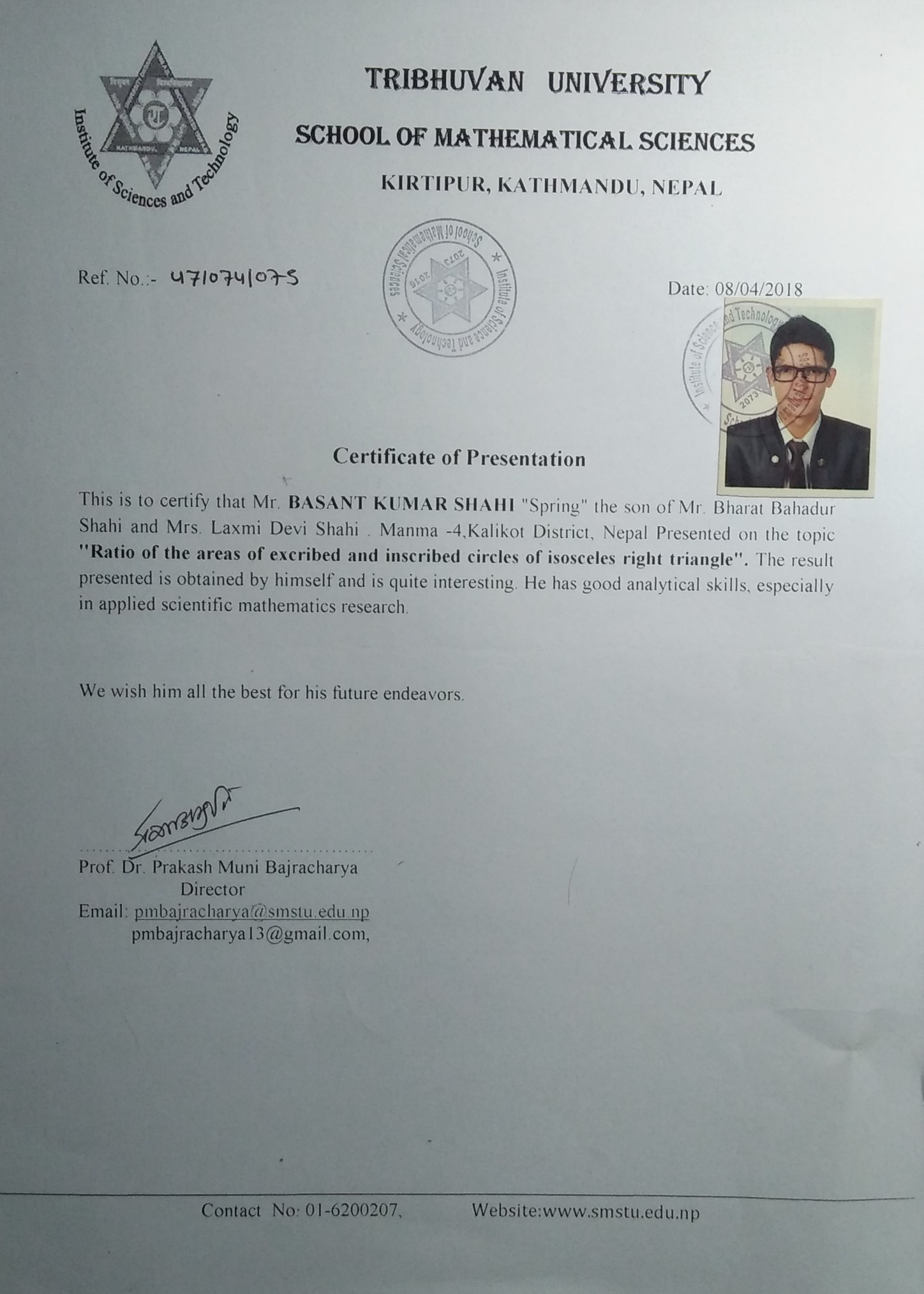
Ratio of the area of escribed and inscribed circle of on isosceles right triangle
No one is allowed to sell, rewrite, or prohibit this work as it is fully copyrighted by Principal Investigator Basant Kumar Shahi
Title: Ratio of the area of escribed and inscribed circle of on isosceles right triangle
Background and Problem Statement:
The calculation of the inscribed and escribed areas of a right isosceles triangle can be challenging, especially for beginners in geometry. Existing formulas for these calculations involve complex equations that may be difficult to understand and apply. Hence, there is a need to develop a simpler and more efficient formula that can be easily applied to obtain accurate results. The objective of this research is to derive and determine the SAR Constant and investigate its applications in calculating the inscribed and escribed areas of right isosceles triangles.
Research Questions:
What is the relationship between the area of a right isosceles triangle and the area of the circle inscribed in it?
What is the relationship between the area of a right isosceles triangle and the area of the circle escribed about it?
How can the SAR Constant be derived and what is its value?
What are the practical applications of the SAR Constant in calculating the inscribed and escribed areas of right isosceles triangles?
Objectives:
To investigate the relationship between the area of a right isosceles triangle and the area of the circle inscribed in it.
To investigate the relationship between the area of a right isosceles triangle and the area of the circle escribed about it.
To derive and determine the Spring Constant and establish its empirical value.
To explore the practical applications of the Spring Constant in calculating the inscribed and escribed areas of right isosceles triangles.
Methodology:
This research will employ a quantitative approach to investigate the research questions and achieve the objectives. The study will involve the use of a sample of right isosceles triangles with varying sizes to calculate their inscribed and escribed areas using existing formulas. The areas will be recorded and analyzed using statistical software to establish their relationships with the areas of the circles inscribed and escribed about them. The SAR Constant will be derived by developing an equation that relates the areas of the triangles and circles, and its value will be determined empirically. The practical applications of the SAR Constant will be explored through the calculation of the inscribed and escribed areas of right isosceles triangles of different sizes.
Expected Outcomes:
This research is expected to provide a simpler and more efficient formula for calculating the inscribed and escribed areas of right isosceles triangles. The derivation of the SAR Constant and its value will enhance the understanding of the relationships between the areas of the triangles and circles. The practical applications of the Spring Constant will facilitate the accurate and efficient calculation of the inscribed and escribed areas of right isosceles triangles in different fields such as construction, engineering, and architecture.
General Objectives:
The main goal of this project is to develop a method to easily find the inscribed and escribed areas of circles and triangles.
Specific Objectives: To achieve this goal, the project aims to:
Develop accurate measurement techniques for determining the inscribed and escribed areas of circles and triangles.
Teach these techniques to students at all levels of education, from primary school to higher education.
Develop a user-friendly platform that can be used by students and educators alike to easily find the inscribed and escribed areas of circles and triangles.
Utilize Auto-CAD 2007 for validating the measurement techniques and to develop more accurate and efficient methods.
Data Collection Tools:
The project will utilize a variety of tools to collect data, including:
Graph paper for drawing circles and triangles.
Measuring scales for accurate measurements.
Compass for drawing circles.
Pencils for sketching.
Auto-CAD 2007 for validation and developing efficient methods.
Reference: The following references will be used for the project:
Eucild’s Elements 2012 A.D. Published
Geometry, a comprehensive course Daniel Pedoe 1970 A.D. Published.
Geometry and Visual Arts Daniel Pedoe 2002 A.D. Published
Conceptual Framework:
c
d
h p
e
d
A b r r B
“Spring’s Law“
“Four times of the area of circle is directly proportional to the area of the isosceles right triangle”
| …….. (I) |
Let’s, ABC be the isosceles right triangle
AB = b be the base of the triangle and BC= p be the perpendicular of the triangle. AB and BC is isosceles right angle.
O be the central point of the given circle.
r be the radius of the circle
(Where, “P” and “b” be the length of the isosceles triangle)
i.e.
(Where, “K” is the Constant)
K= 2.156048
| K= …….(II) |
k= (d= 2r)
In triangle right triangle AHB,
AH = d be the base of the triangle and BH= d be the perpendicular of the triangle AHB. AH=BH
According to the Pythagoras theorem
d= r+
Taking common r both side we get,
d= .r
By symmetry, we have known that.
h= d
h= 2d
AC= h be the hypotenuse of the triangle ABC.
We have,
p=b =p
p=
p= d
Putting the value d we get,
p= .r.
Both side square we get,
=
.
| 2 |
Again,
K=
Putting the value, we get,
K=
| k=
Equivalently to K= |
K= 2.156048
(Where K is the constant)
(Where, r is the given diameter of the circle. p be the length of the isosceles triangle.)
Definition of the Constant:
“It is can be defined as the ration of the eight times areas of circle and areas of isosceles right triangle”
be the diameter of the next circle.
= +
(According to the Pythagoras theorem = +)
Perpendicular and base of the right isosceles triangle are equal i.e. p=b
2=
Taking both side square roots, we get
=
=
From,
=
P=
Now,
Using the value of “p”
=
=
= 2d
| = 2d |
(Where,)
Again,
= 2d
=
= . 2d
= 4d
= . 4d
= 8d
= . 8d
= 16d
= . 16d
= 32d
” ” “
” ” “
=
| = .d
= .r
|
Where, “n” be the no. of circle counting without given circle.
| S.N. | Radius of
the Circle(r) |
Length of the
triangle (p=b) |
Constant (K) | Ratio of the first radius r and next radius R. R= 2r
= 2.414213 |
| 1. | r= 2.5 cm
6.25 |
2
= 6.25 = 72.855339 |
K=
= = 2.156048 |
R= 2*2.5
R= 6.035534 = 2.414213 |
| 2. | r= 4 cm
16 |
2
= 16 = 186.5096664 |
K=
= = 2.156048 |
R= 2*4
R= 9.656855 = 2.414213 |
| 3. | r= 4.65 cm
21.6225 |
2
= 21.6225 = 252.050325 |
K=
= = 2.156048 |
R= 2*4.65
R= 11.226093 = 2.41421 |
| 4. | r= 10.5 cm
110.25 |
2
= 110.25 = 1285.168153 |
K=
= = 2.156048 |
R= 2*10.5
R=25.3492365 = 2.41421
|
| 5. | r= 25 cm
625 |
2
= 625 = 7285.53375 |
K=
= = 2.156048 |
R= 2*25
R= = 2.41421 |
| 6. | r= 49 cm
2401 |
2
= 2401 = 27988.106454 |
K=
= = 2.156048 |
R= 2*49
R= 118.296437 = 2.41421 |
| 7. | r= 80.02 cm
6403.2004 |
2
= 6403.2004 = 74641.172195 |
K=
= = 2.156048 |
R= 2*80.02
R= 193.185324 = 2.41421 |
| 8. | r= 200 cm
40000 |
2
= 40000 = 466274.16 |
K=
= = 2.156048 |
R= 2*200
R= 482.8426 = 2.41421 |
| 9. | r= 950 cm
902500 |
2
= 902500 = 10520310.735 |
K=
= = 2.156048 |
R= 2*950
R= 2293.50235 = 2.41421 |
| 10. | r= 3000 cm
9000000 |
2
= 9000000 = 104911686 |
K=
= = 2.156048 |
R= 2*3000
R= 7242.639 = 2.41421 |
Conclusion:
By deriving an empirical constant that relates the area of an isosceles right triangle to that of a circle inscribed in it, we will provide a simple and accurate formula for finding the inscribed and exscribed areas of isosceles right triangles. This study will have implications for geometry education at all levels. The SAR constant, once derived, can be used as a tool for teaching geometry to students and also for further research in geometry.
Reference:
The following references will be used for the project:
Eucild’s Elements 2012 A.D. Published
Geometry, a comprehensive course Daniel Pedoe 1970 A.D. Published.
Geometry and Visual Arts Daniel Pedoe 2002 A.D. Published.